
A practical 90-day framework to transfer authority, records, and beneficiary communication without governance gaps.
Trustee transitions fail when families treat them like paperwork instead of an operating handoff.
A clean transition is not just moving accounts. It is moving authority, decision logic, beneficiary expectations, and advisor coordination into one repeatable system.

If you are replacing a trustee or moving from an individual trustee to a professional model, use this 90-day framework to avoid delays, disputes, and rework.
Why transitions break
Most breakdowns come from four gaps:
- Authority is legally transferred, but decision workflows are not.
- Historical files arrive in fragments, not in an audit-ready package.
- Beneficiaries are notified too late or with vague language.
- CPA, attorney, and investment advisor handoffs are informal.
The result is predictable: distribution slowdowns, inconsistent messaging, and avoidable friction in the first quarter.
The 90-day transition framework
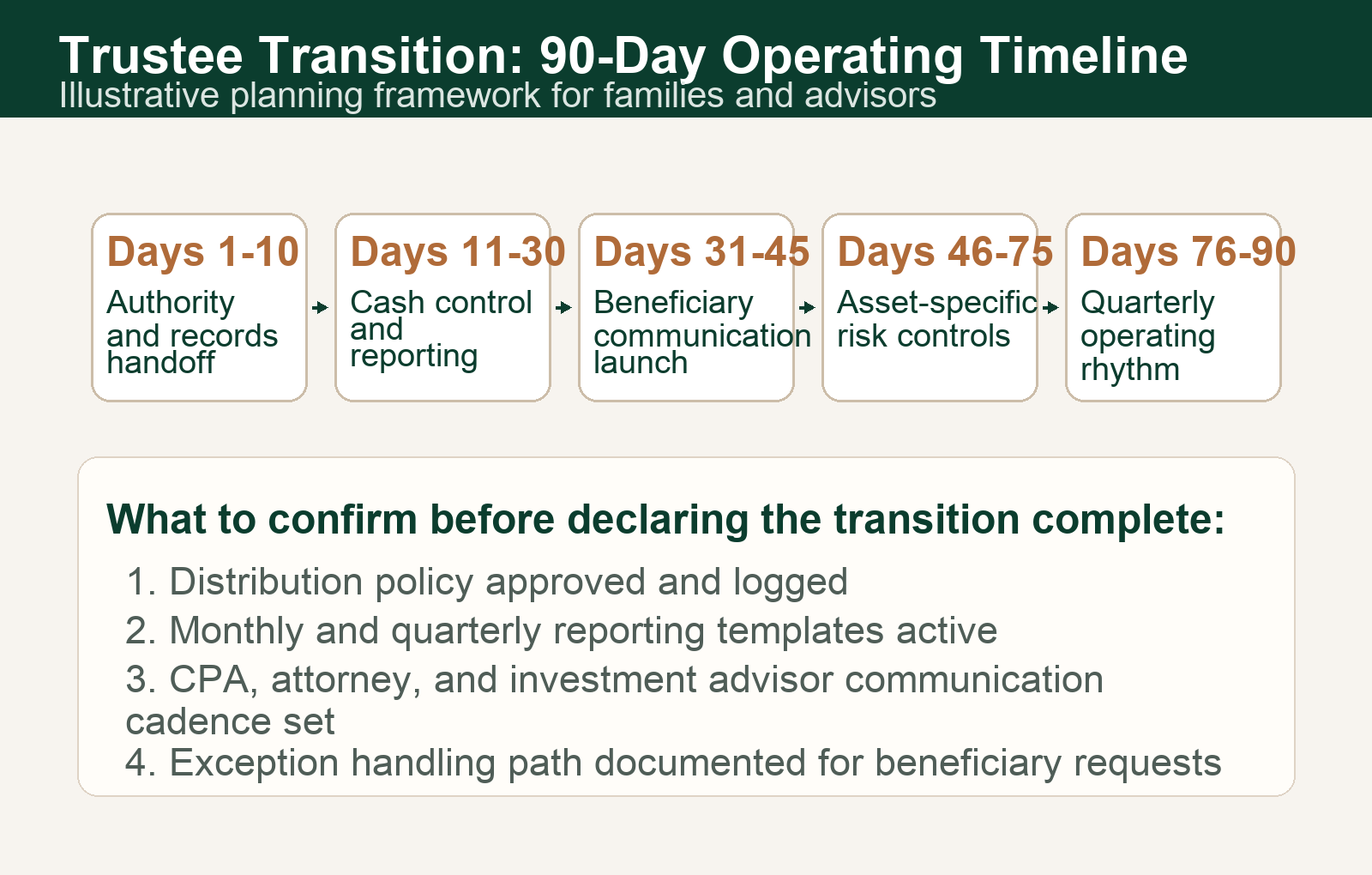
Phase 1 (Days 1-10): control and records
Objectives:
- Confirm governing documents, acceptance authority, and key dates.
- Freeze ad hoc exceptions until process controls are active.
- Inventory all accounts, entities, and outstanding requests.
Deliverables:
- Authority map (who approves what).
- Consolidated document index.
- Immediate-risk register.
Phase 2 (Days 11-30): cash and reporting baseline
Objectives:
- Establish distribution intake and approval path.
- Align cash forecasting with investment operations.
- Define monthly reporting package.
Deliverables:
- Distribution request form + decision log.
- 13-week liquidity view.
- Beneficiary reporting template.
Phase 3 (Days 31-45): communication reset
Objectives:
- Set one communication standard for all beneficiaries.
- Clarify timing and scope for updates.
- Reduce inbound confusion through proactive outreach.
Deliverables:
- Standard communication cadence.
- FAQ for common process questions.
- Escalation path for exceptions.
Phase 4 (Days 46-75): complexity controls
Objectives:
- Add controls for trust-owned entities, real estate, and concentrated positions.
- Define cross-functional review triggers.
Deliverables:
- Special asset governance checklist.
- Exception policy for non-standard requests.
Phase 5 (Days 76-90): lock operating rhythm
Objectives:
- Move from transition mode to steady-state governance.
- Confirm ownership and SLAs across trustee, advisor, CPA, and counsel.
Deliverables:
- Quarterly operating calendar.
- KPI baseline (response time, cycle time, exception rate).
Transfer package checklist (minimum viable)
| Area | Minimum package | Owner |
|---|---|---|
| Legal docs | Governing trust docs, amendments, acceptance records | Counsel + trustee |
| Financial records | Prior statements, distribution history, open obligations | Trustee ops |
| Tax | Prior returns, K-1 workflow, estimated payment plan | CPA |
| Advisor workflows | Liquidity protocols, rebalance constraints, cash windows | Investment advisor |
| Beneficiary communications | Contact matrix, prior notices, unresolved issues | Trustee relationship lead |
Transition SLAs worth setting early
Set these before day 30:
- Standard response time for inbound beneficiary requests.
- Maximum cycle time for routine distribution decisions.
- Turnaround window for CPA/counsel document requests.
- Escalation response standard for high-priority issues.
Without explicit SLAs, families often experience inconsistent service quality during the most sensitive period.
What families should ask on week one
- What is the exact workflow from request intake to final decision?
- Where are exceptions documented and approved?
- Which reports are delivered monthly vs quarterly?
- How do trustee, advisor, CPA, and attorney share updates?
- Who is accountable when timing slips?
If those five answers are not clear in writing, the transition is not complete.
Practical next step
If your family is preparing a trustee change in Overland Park or elsewhere, start by stress-testing your handoff process before documents move.
Use the Trust Audit Scorecard to identify your highest-risk transition gaps, or contact our team for a working session.
Educational content only; not legal, tax, or investment advice. Consult qualified professionals for guidance.