
A practical decision-tree and scoring framework for consistent distribution governance and beneficiary communication.
Distribution requests are where trust governance becomes real.
If your process is unclear, even reasonable requests can become slow, inconsistent, and emotionally charged. A strong policy gives beneficiaries clarity while protecting trustee discretion and fiduciary duty.

This template is a practical framework for building a distribution process that is both humane and defensible.
What a strong distribution policy should do
- Set clear intake requirements.
- Define decision criteria before requests arrive.
- Separate routine approvals from exception cases.
- Create auditable records for every decision.
- Standardize beneficiary communication timing.
Decision tree template
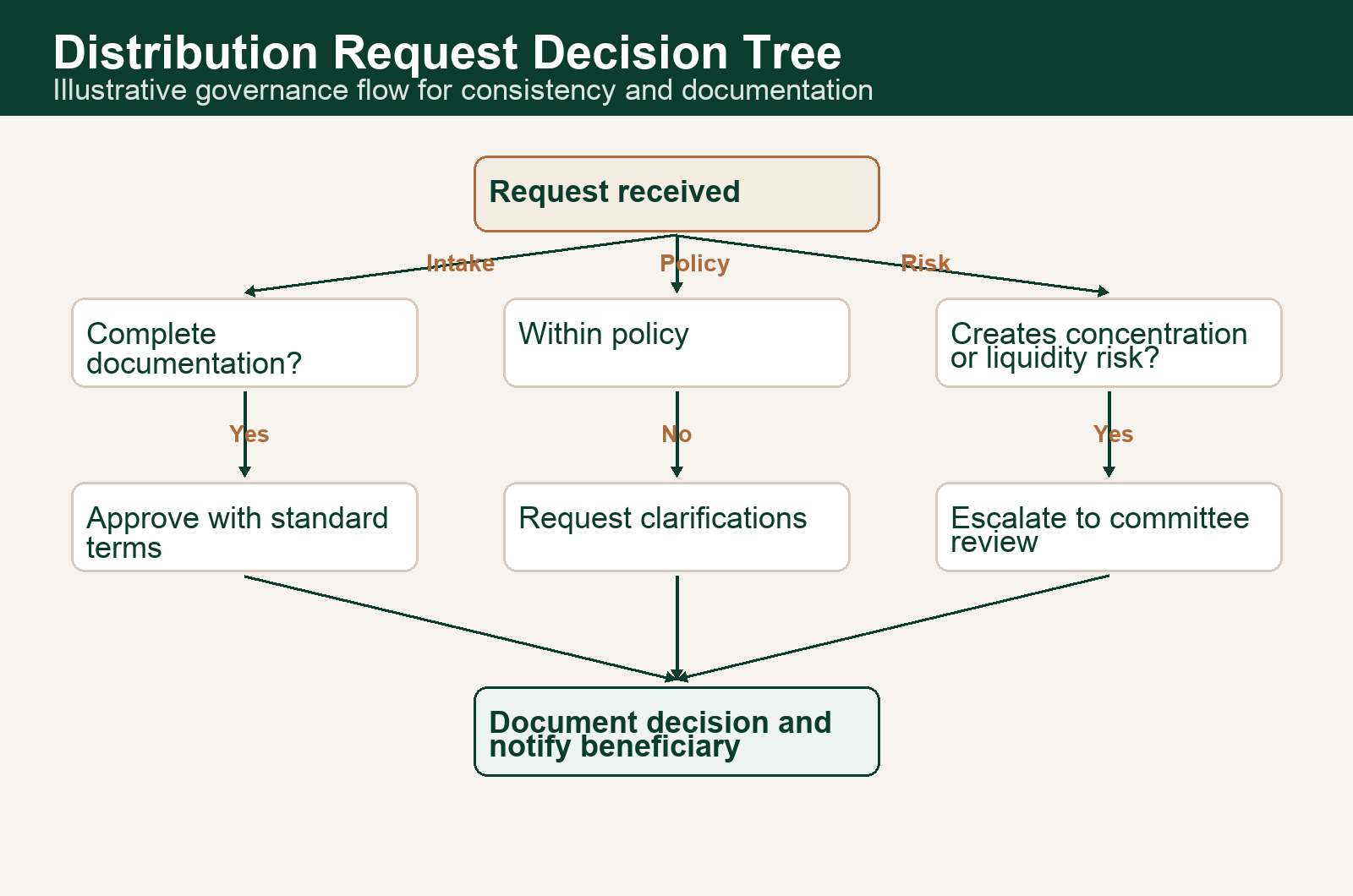
Use the following sequence for every request:
- Confirm request completeness (purpose, amount, timing, supporting context).
- Evaluate against trust language and policy standards.
- Check liquidity and concentration implications.
- Route routine cases to standard approval path.
- Route exception cases to escalation committee.
- Document final rationale and communicate outcome.
Suggested scoring framework (illustrative)
| Criterion | Weight | Score 1 | Score 3 | Score 5 |
|---|---|---|---|---|
| Alignment with trust purpose | 30% | Weak alignment | Partial alignment | Strong alignment |
| Beneficiary need urgency | 25% | Low urgency | Moderate urgency | Time-sensitive need |
| Long-term fairness impact | 25% | Potential imbalance | Neutral impact | Clearly fair and consistent |
| Liquidity and portfolio impact | 20% | High disruption | Manageable | Minimal disruption |
A weighted score does not replace judgment. It makes judgment more consistent and explainable.
Communication script template
For approved requests:
- Decision summary
- Timing and mechanics
- Any conditions or follow-up requirements
For deferred or declined requests:
- Acknowledge request and context respectfully
- State policy basis for current outcome
- Provide next review path or additional information needed
Consistency in tone is as important as consistency in process.
Policy governance controls
- Maintain one live decision log with timestamps and approvers.
- Review exception patterns monthly.
- Audit response-time compliance quarterly.
- Revisit policy language annually with counsel.
Common mistakes to avoid
- Making one-off exceptions without recording rationale.
- Letting urgency bypass documented review.
- Communicating decisions differently across beneficiaries.
- Treating policy as static when family needs evolve.
Practical next step
If distribution decisions currently feel reactive, start by implementing the decision tree and one-page scoring sheet before your next request cycle.
You can use our Trust Audit Scorecard to identify policy gaps, then contact us to build a tailored operating playbook.
Educational content only; not legal, tax, or investment advice. Consult qualified professionals for guidance.